

The Storm Whale
Written and Illustrated by Benji Davies
Hello, and happy Tuesday! In this week’s newsletter, we’ve got an Arnold Lobel biography, a question and answer book as captivating for children as it is for adults, epigraph lore from a 20th-century British author, and of course, a storm whale. It’s so much goodness, it will probably cut off in your Inbox—so be sure to click over to read the full post in your browser. Enjoy!













It’s hard to remember a time when THE STORM WHALE wasn’t a part of our home library. One of the first picture books I purchased when my kiddo transitioned out of board books, THE STORM WHALE inspired and excited me—especially after the many books about blue trucks and sleepy construction sites that had been in the well-worn rotation.
Instead, here was a book that incorporated big, heavy themes with a touch of humor, and an ambiguous, slightly unsettling end. Indeed, the first time I ever read THE STORM WHALE, I recall thinking, “That’s it? Huh. I don’t know if I like this book.” But read after read, it stayed with me.
And then there’s the epigraph at the front of the book, which cemented THE STORM WHALE’s place in my “never-gonna-give-away” list of picture books. (More on that at the end of the review!)
The authorial debut of author-illustrator Benji Davies, if you don’t already know Noi and the little storm whale, it’s time you met them both.
Let’s sail away…

“Noi lived with his dad and six cats by the sea.”
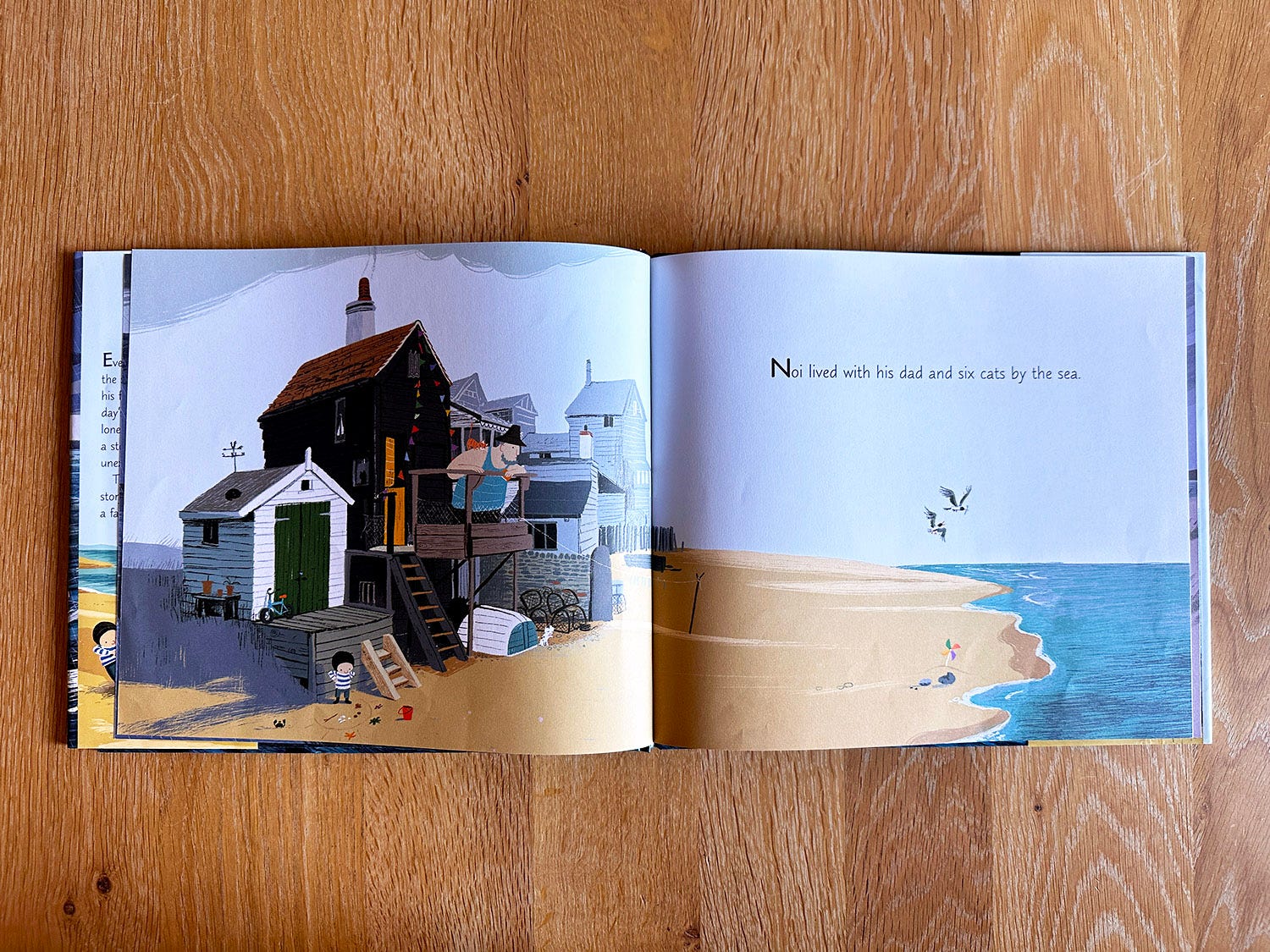
It never ceases to amaze me how such a simple opening line is so transporting. But then again, Davies’ art plays a big supporting role, too—you can practically hear the waves crashing and smell the briny sea air as you search the opening spread for all six cats. My own daughter loved studying this scene and uncovering new details: The pinwheel lodged in the sand. Seagulls fighting over a fish. Noi’s sunny sand drawing, and the little crab watching him.
Beyond the artwork, we glean two big things from this opener: Noi’s mom does not live with them, and—though it’s never stated—there is a sense of loneliness and isolation here.
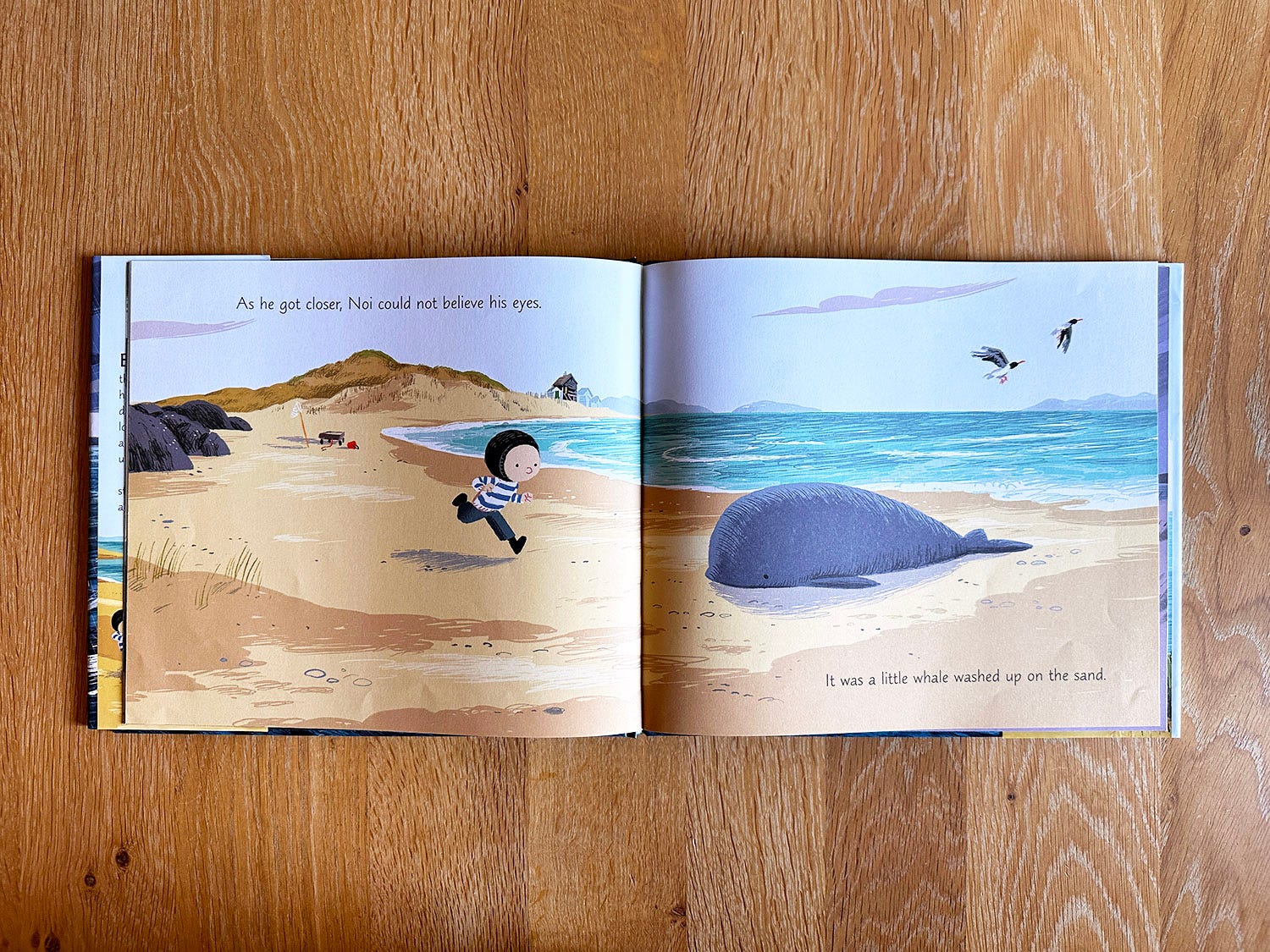
Sure enough, on the next page we learn that Noi’s dad is a fisherman. Every morning, he leaves Noi behind as he ventures out to sea for a long day on his boat, never returning before dark. Alone, Noi spends his days wandering the shoreline.
But one morning, following a great storm, Noi finds the surprise of his life…
A little whale has washed up on the beach. And it’s still alive!

Here, with a light hand, Davies introduces the fantastic and endearing. Noi knows a whale should not be out of water. In a classic line, he thinks, “I must be quick! ” and loads the tiny whale onto his wagon…
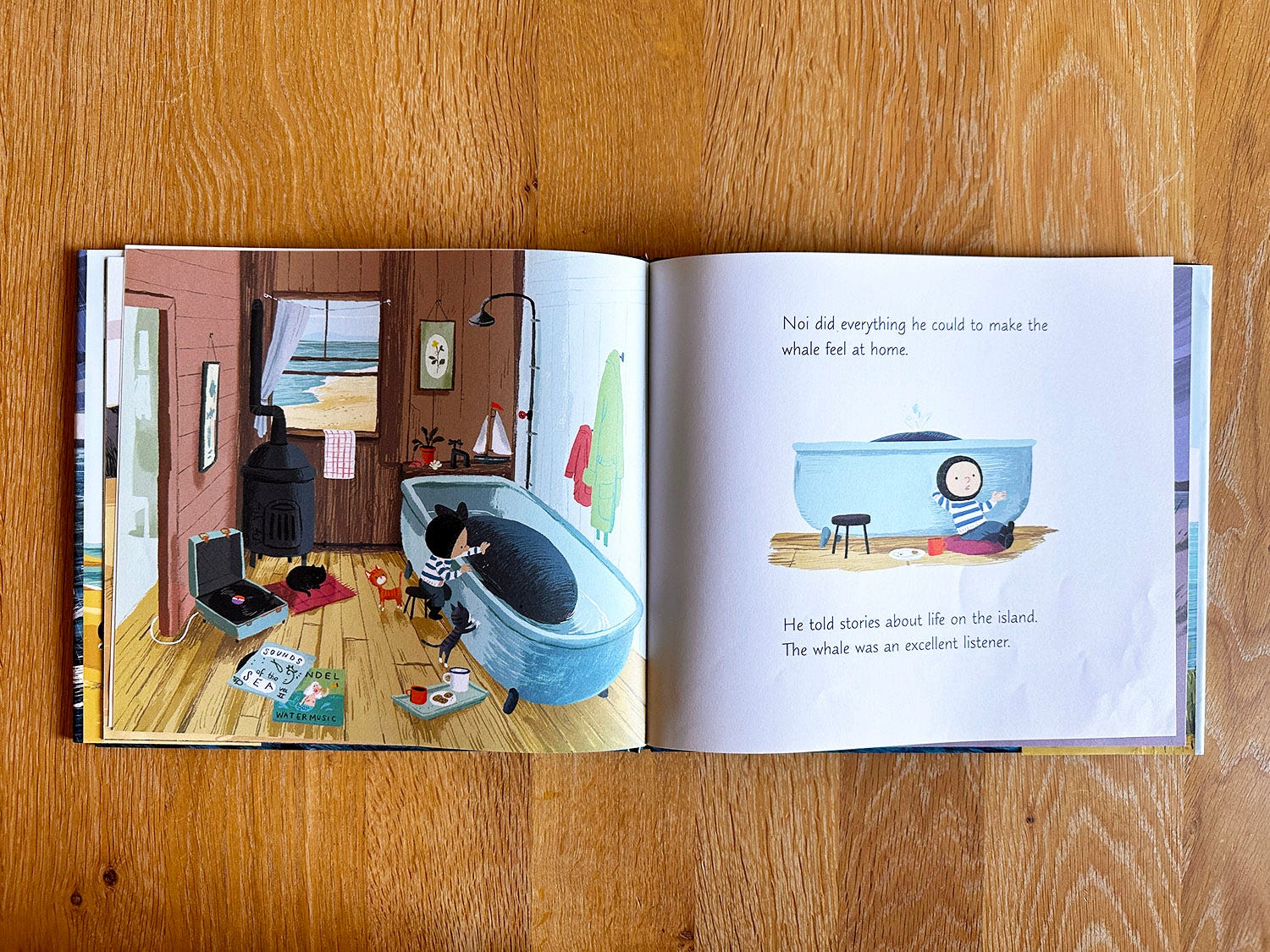
…then into the bathtub at home.
He plays the whale music.
Tells it stories.
(The whale, as it happens, is “an excellent listener.”)
Part of me wanted to see Noi’s adventures with the whale unfold for the entirety of the book! But alas, Davies brings us back to reality.
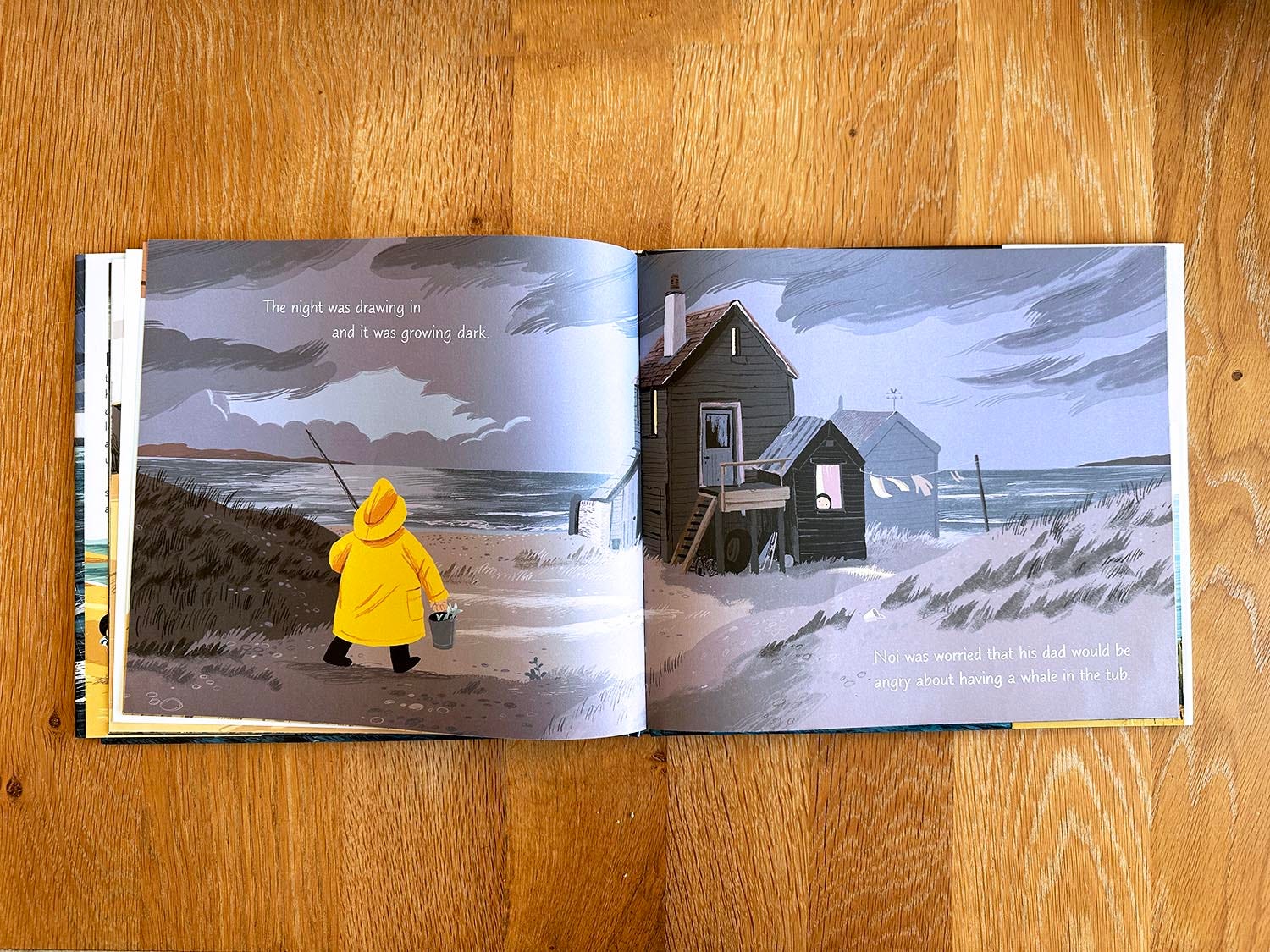
Night falls, and via the art, we see Dad returning home. In a masterful bit of picture book writing, Davies explains, “Noi was worried that his dad would be angry about having a whale in the tub.”
This line always stuck with me. On the surface, it’s a simple bit of interiority that moves the story forward. And it seems obvious on the face of it—parent returns home to find chaos! Of course it’s an issue!
But it also stuck with me because Noi uses the word angry. Not upset. Not flabbergasted. Not incredulous. Angry. The line subtly tells us something about Noi and Dad’s relationship—that maybe, there is some distance, or misunderstanding, or even loneliness for both of them in that house by the sea. Or, worse, that Noi is afraid of his father. Why?, I wondered.
(This is important, as it sets us up for the resolution at the end of the book!)
And then…
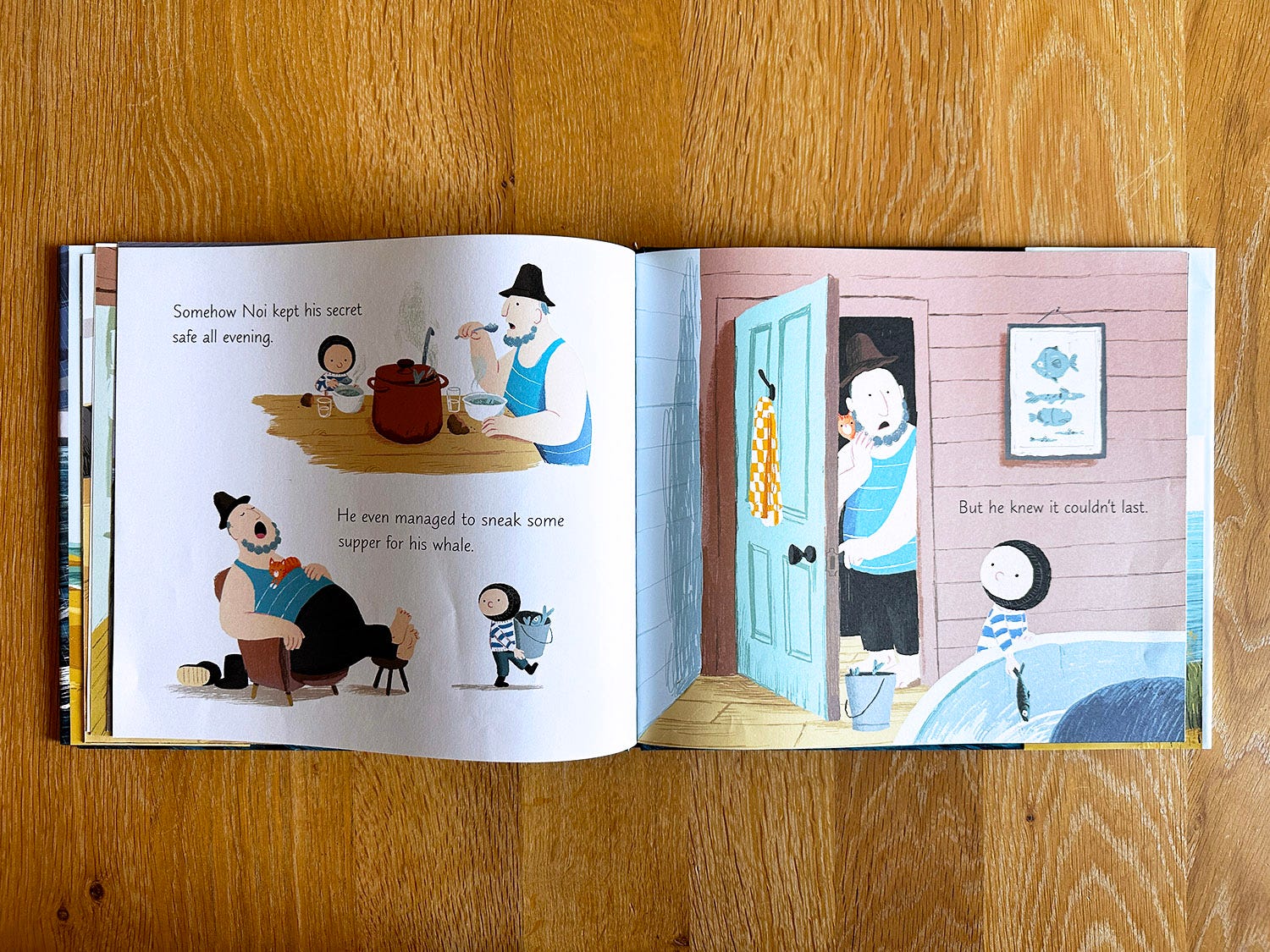
Dad returns home and doesn’t immediately notice what’s transpired. But let’s be honest—it’s quite difficult to keep a secret whale in the bath for very long.
How will Dad react?

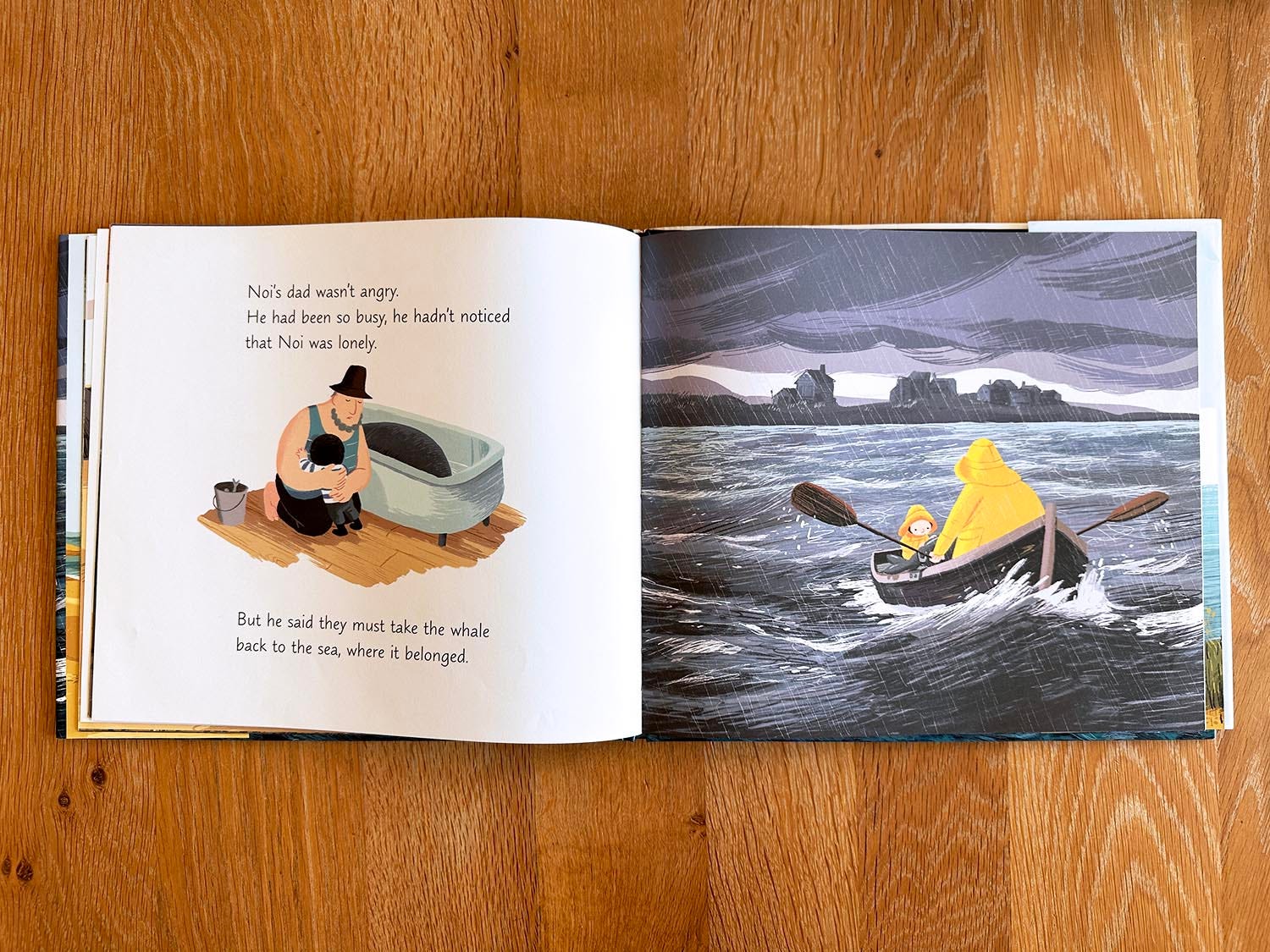
Phew—Davies tells us right away. Noi’s dad “wasn’t angry. He had been so busy, he hadn’t noticed that Noi was lonely.”
Still, with this admission, Davies manages not to let all the air out of the balloon—there’s the matter of a whale in the bath to deal with. To this, Dad says, “they must take the whale back to the sea, where it [belongs].”
I love Dad’s embrace of Noi in this illustration, and their matching yellow fishing jackets and hats. We sense repair taking place, as we come to understand Dad’s perspective (busy, didn’t mean to ignore his son), see the emotional shift (the hug) and have it reinforced visually (twinning outfits that symbolize “together”).
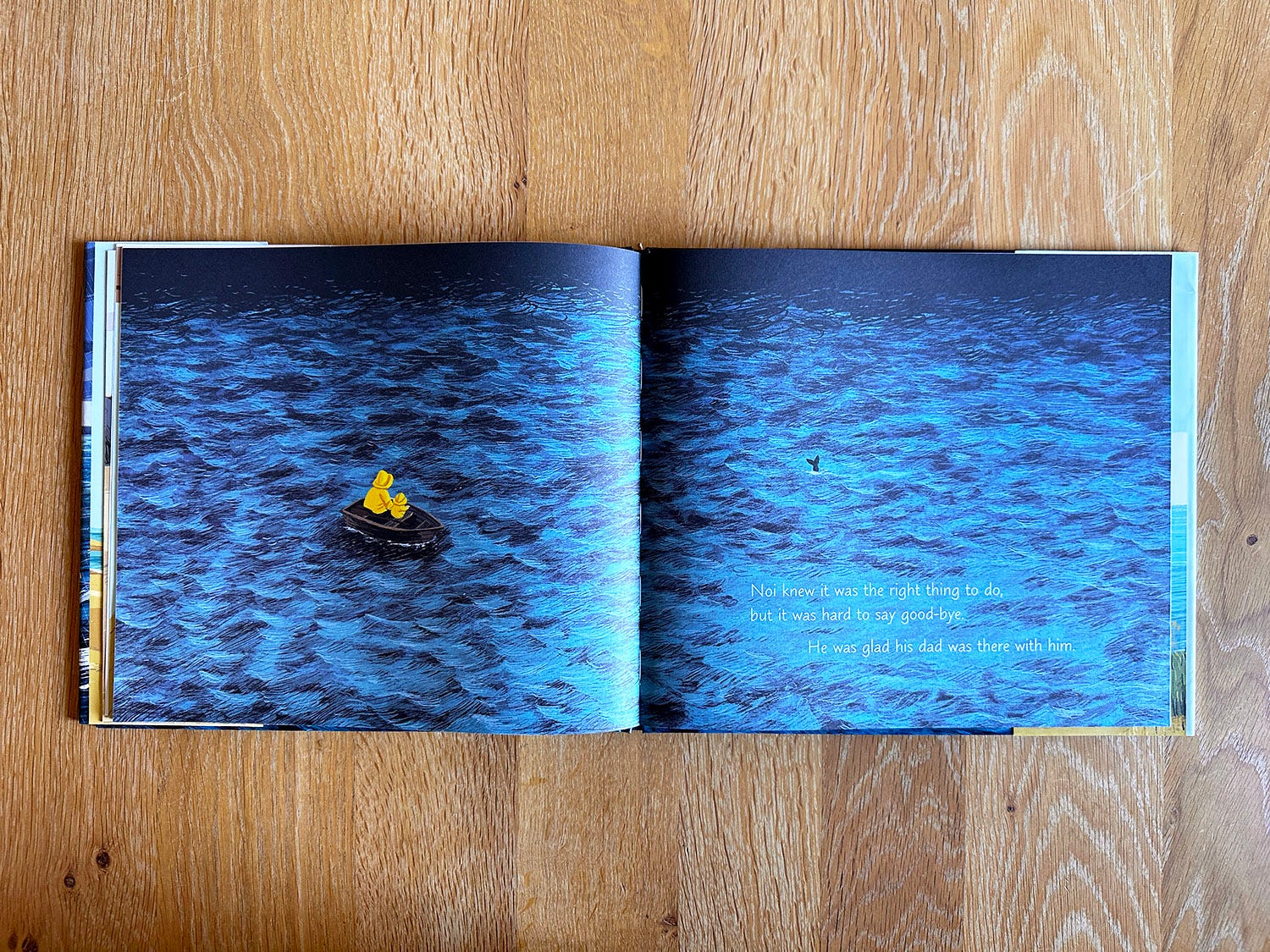
Let’s pause and give a moment for this spread, and all of the incredible pen work that creates this vast ocean. The tones, the movement in the waves—it still gets me!
In the denouement, Davies depicts Dad at home, caring for Noi. It’s daylight hours, and though that sense of spareness and isolation still exists in this beachfront world, Dad and Noi are together, looking content.
Noi, we learn, thinks often about the storm whale.
“He hoped that one day soon…he would see his friend again.”
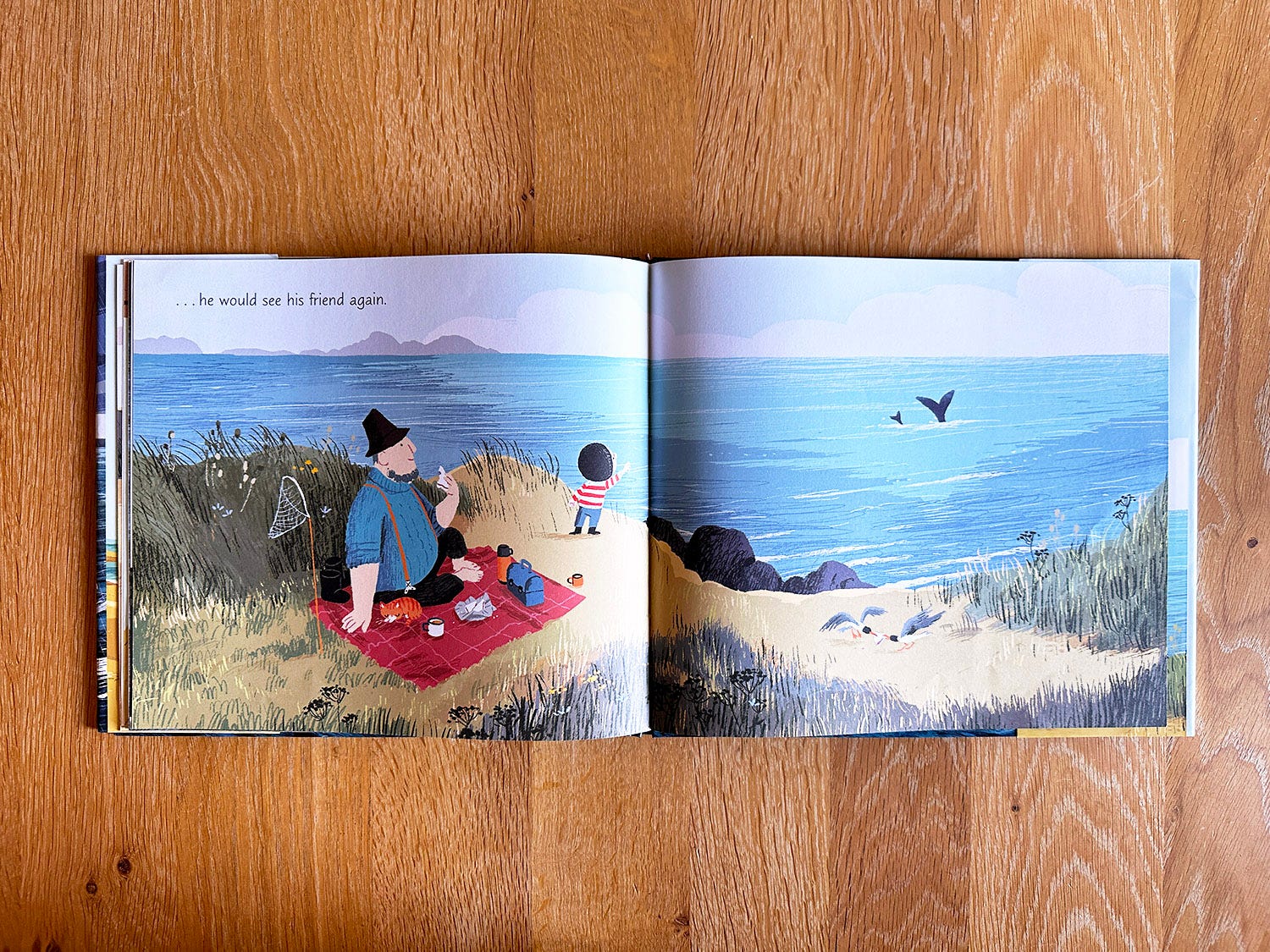
And that’s it. That’s the book. What an (open) ending, huh?
If you ever read user-generated reviews of THE STORM WHALE, some buyers complain about such an ambiguous ending. But not me! I love it! As humans, we must grapple with the unknown, and with loss, hope, and fantasy all the time—often at the same time, too. Noi wishes and hopes he’ll see his friend in the future, to know the whale’s okay. But if he doesn’t, he must take heart in the fact that he did the best he could. And at the same time, the experience brought him closer to Dad.
Life is full of give and take.

It’s not a spoiler to tell you…Noi does meet the storm whale again! Want to find out how? Following the success of THE STORM WHALE in 2013, Davies published a whole slew of sequels, starting with THE STORM WHALE IN WINTER.
Curious about the name Noi? I was, too. It’s a word and name that appears in many languages and cultures, with lots of meanings:
Japanese: “Honest” or “truthful”.
Thai: “Little one” or “small,” often used as a term of endearment.
Finnish: “Clever” or “witty”.
Hebrew: “Pleasantness” or “delight”.
Icelandic: Sometimes spelled with an accent (Nói), it is the Icelandic form of the name “Noah.” The word nói can also mean “small vessel.”
Italian: The pronoun “noi” means “we” or “us”.
Hark! In this interview, Davies gives it to us straight—he’s thinking of the Icelandic version.
Finally, an end note to end all end notes. Without a doubt, my favorite part of THE STORM WHALE is this epigraph:
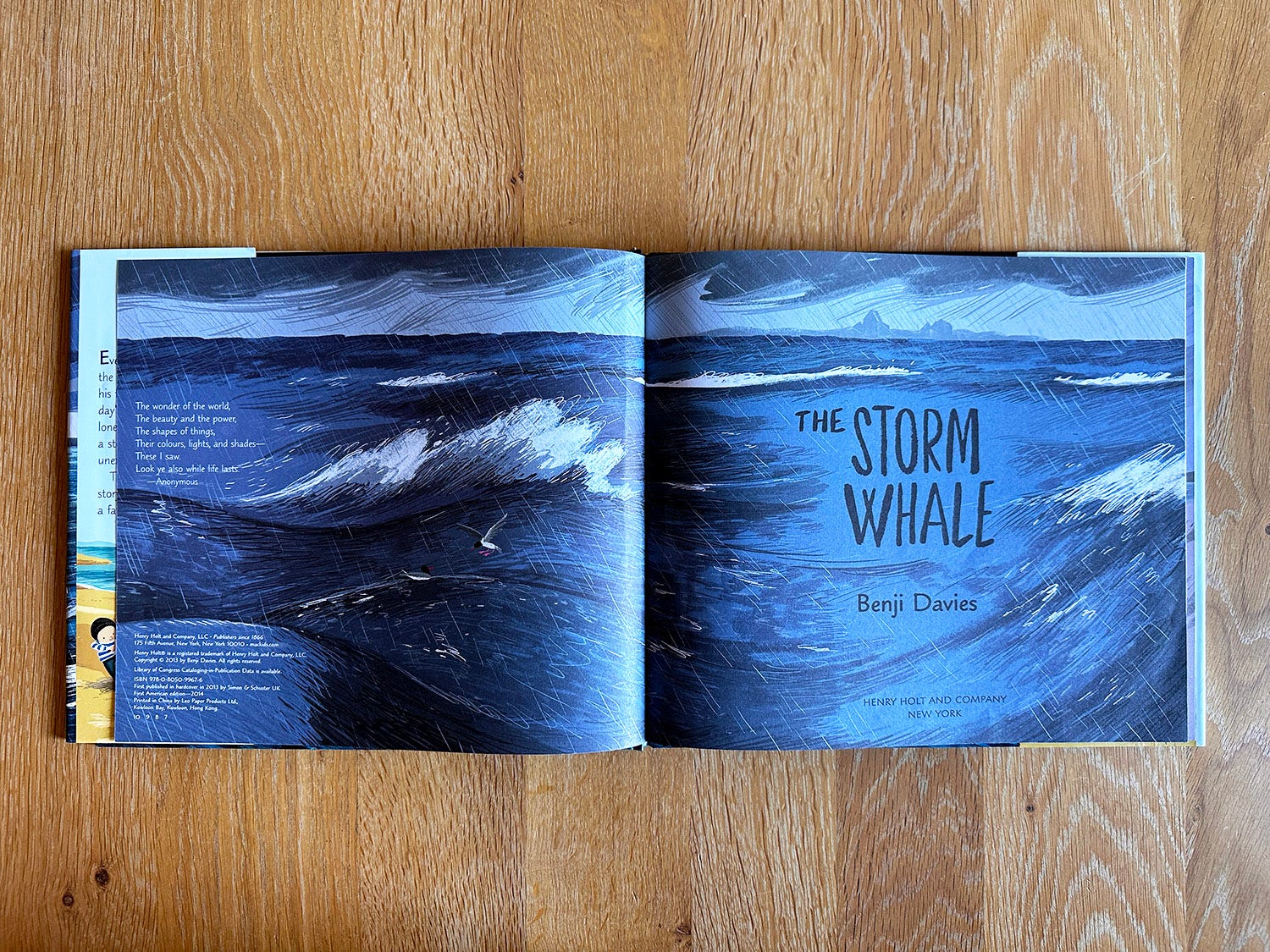
It reads:
The wonder of the world,
the beauty and the power,
the shapes of things,
their colours, lights and shades—
these I saw.
Look ye also, while life lasts.

—Anonymous
I used to read this to my daughter every time we opened the book. By the time she was 3, she could recite it back to me, and it was the cutest, most wonderful thing ever.
But I wondered—who was Anonymous? Where did this poem come from?
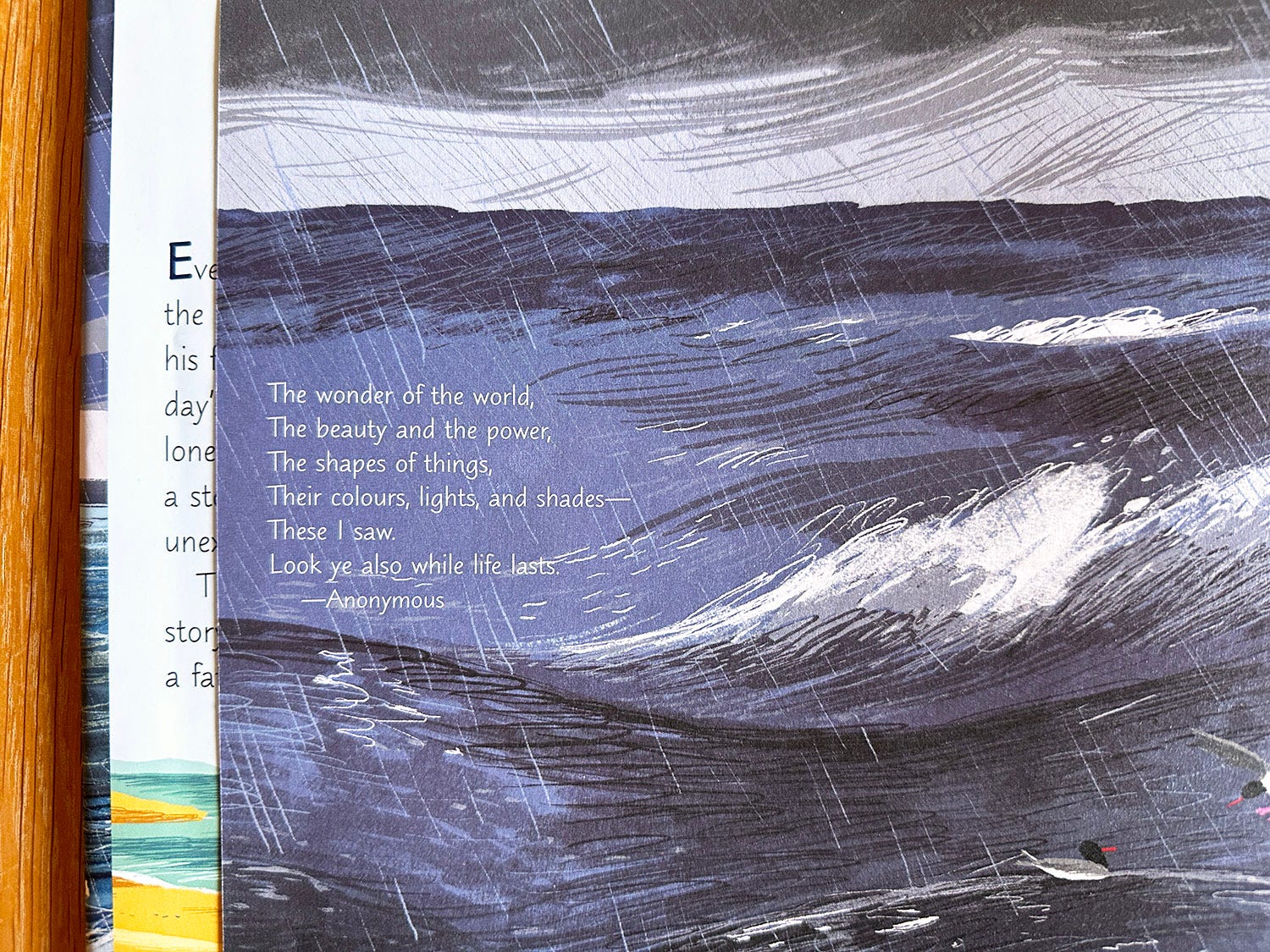
A few years ago, I looked into it, and discovered Denys Watkins-Pitchford. Born in 1905, Watkins-Pitchford was a British children’s book author and artist, who often wrote under the pen name “B.B.”, a name “based on the size of lead shot he used to shoot geese.” As an illustrator, he always used his real name—perhaps because he’d been trained to draw in both Paris and London, and viewed this as his primary trade.
The “wonder of the world” poem was printed inside all of Watkins-Pitchford’s books; some sources I’ve found attribute authorship to him (less likely), while others write that his father copied the tribute from a tombstone in a Scottish churchyard. There does appear to be a monument in East Ayrshire, Scotland bearing these words, so perhaps that old tale is true.
Whether or not Watkins-Pitchford got the words from his father, it would seem the original author remains anonymous. But I can confirm, after purchasing a 1945 edition of Watkins-Pitchford’s THE WAYFARING TREE, that the epigraph does in fact appear in this work, and I’m guessing all of his other ones, too.
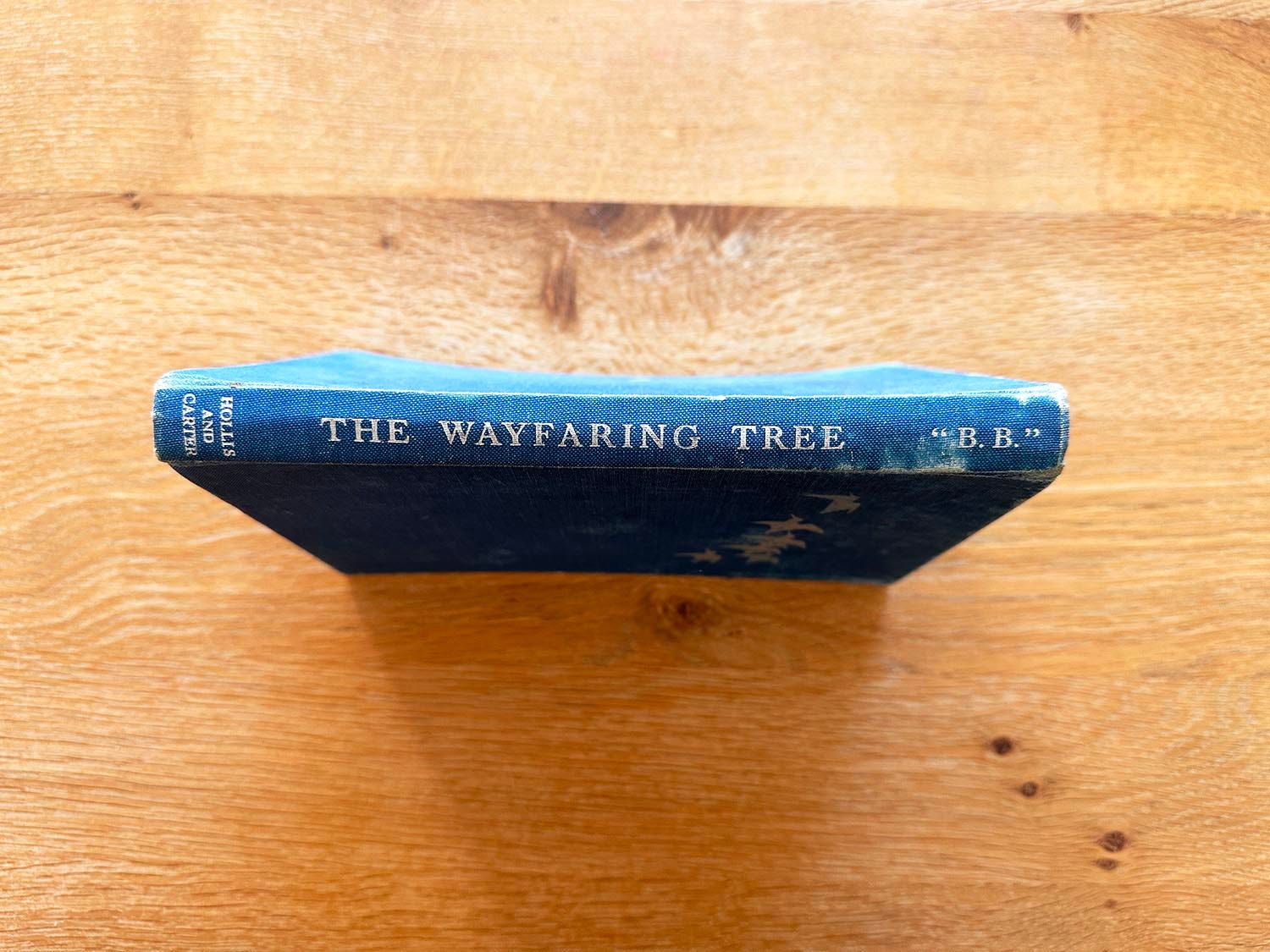
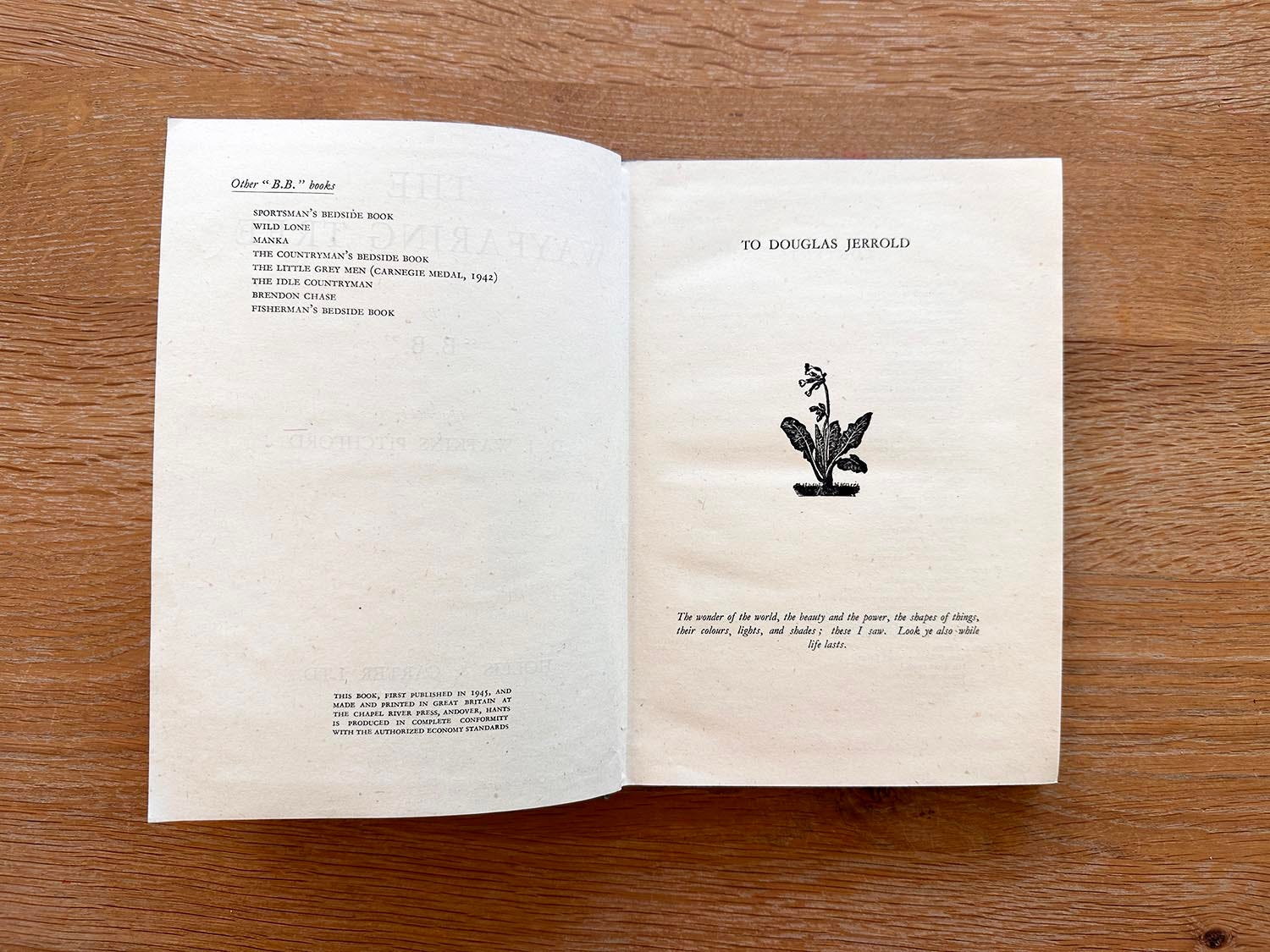
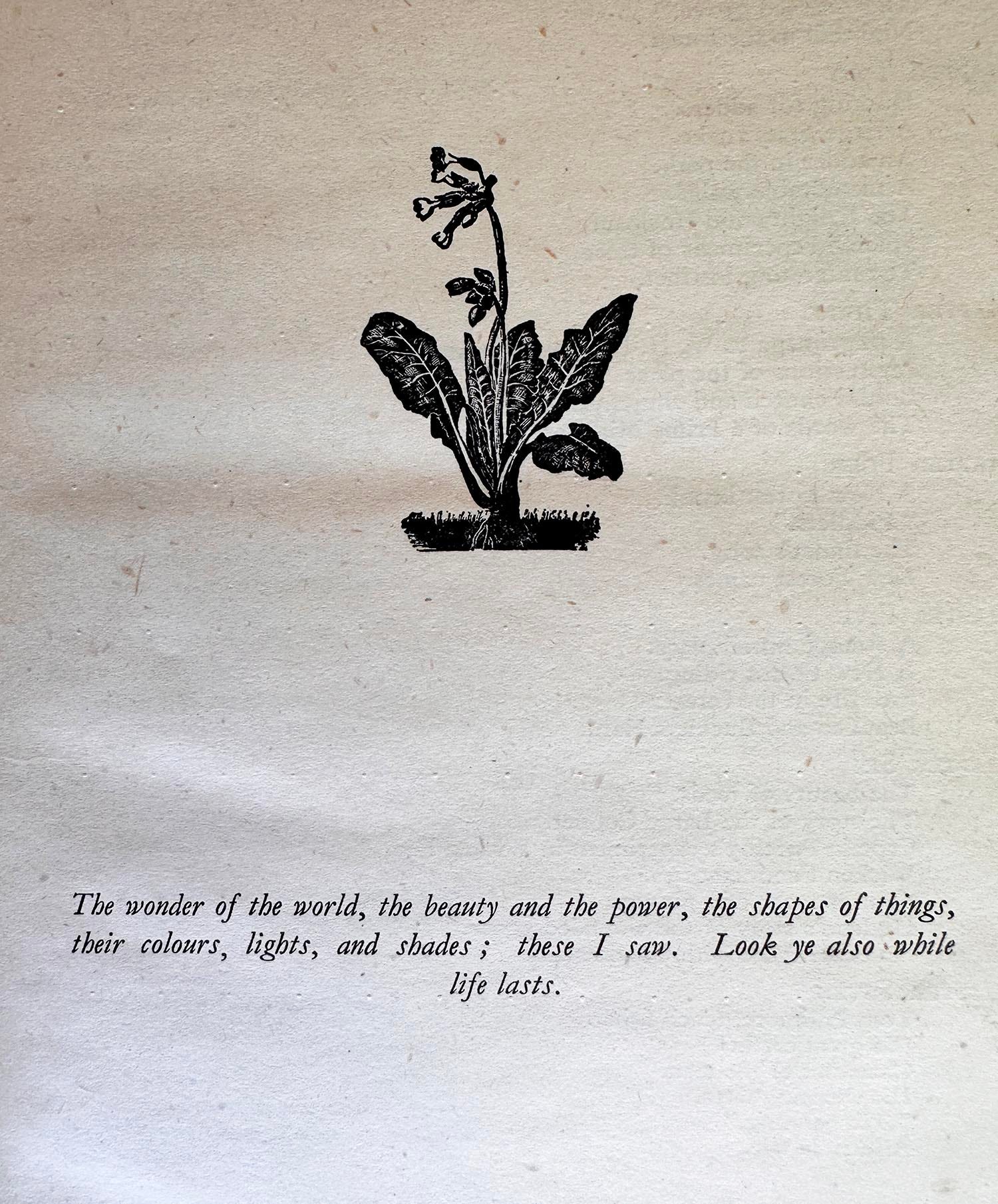
I don’t have any tattoos and don’t know that I’ll ever get one, but if I did, these words would be a top contender.

Support the makers:
Buy your copy:

NEW BOOKS I PUT ON HOLD AT THE LIBRARY:
Super excited for these two!!
The Coziest Place on the Moon by Maria Popova and illustrated by Sarah Jacoby
The Very Fine Clock by Edward Gorey and illustrated by Muriel Spark
Plus these three titles:
Salmon Run: An epic journey to the ocean and back by Annie Chen
I’m Trying to Love Farts by Bethany Barton
How to Find a Yeti by Matt Hunt

MORE NEW BOOKS TO LOOK FOR:
The Invisible World of Germs (…and its impact on our lives) by Isabel Thomas
A Day with No Words by Tiffany Hammond and illustrated by Kate Cosgrove
The Illustrated Encyclopedia of Ocean Life: A Visual Voyage Through an Underwater World by Claudia Martin and illustrated by Marc Pattenden (The art in this has total WHAT A SHELL CAN TELL illustration vibes!)
The Poetry World of John Agard by John Agard and illustrated by Shirley Hottier
Super Great Kids’ Stories: From storytellers around the world by Kim Normanton
The Trouble with Children (According to Dog) by Katie Weaver and illustrated by Caner Soylu
The Trouble with Children (According to Cat) by Katie Weaver and illustrated by Caner Soylu

M E T A
In this Post: The Storm Whale by Benji Davies
Keywords: Father and son stories, whales, ocean, sea, friendship, ambiguous loss, loneliness, rescue, single parent, unlikely friends, parent child repair